Beyond Access: The Hidden Forces That Keep Americans From Choosing Prevention
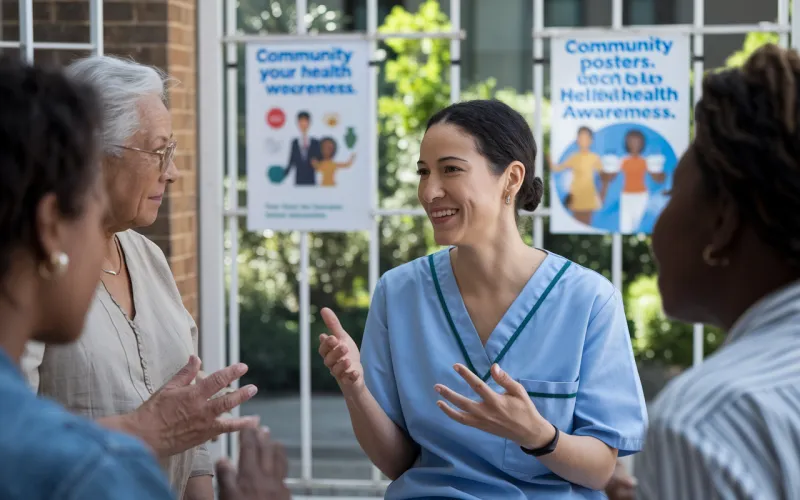
Photo: community health worker talking with residents at free clinic, via cdn.residencyadvisor.com
When Free Isn't Enough
For decades, the dominant assumption in American public health has been straightforward: if you remove financial and geographic barriers, people will seek preventive care. Build the clinic, waive the co-pay, park the mobile screening van in the neighborhood—and they will come.
They often do not.
Data from the Centers for Disease Control and Prevention consistently show that tens of millions of Americans forgo recommended screenings, vaccinations, and wellness visits even when these services are fully covered under their insurance or offered at no cost through community programs. In 2022, fewer than one in three adults between the ages of 50 and 75 reported being up to date on colorectal cancer screening, despite the fact that most insurance plans are federally mandated to cover it without cost-sharing. Flu vaccination rates among working-age adults hover around 50 percent, even in years when vaccines are distributed at no charge in pharmacies, workplaces, and public libraries.
Something deeper than logistics is at play.
The Behavioral Economics of Inaction
Public health researchers have increasingly turned to behavioral economics—the study of how psychological biases shape decision-making—to explain this persistent gap. What they have found is both illuminating and humbling.
One of the most powerful forces is what economists call present bias: the deeply human tendency to overvalue immediate comfort and undervalue future benefits. Preventive care, by its very nature, asks people to invest time and energy today for an outcome they may never see. A colonoscopy might detect a polyp that would have become cancer in a decade. A blood pressure check might prompt lifestyle changes that prevent a stroke years from now. The brain, wired for immediacy, struggles to assign weight to threats that feel distant and probabilistic.
"We are essentially asking people to act on behalf of a future self they don't fully identify with," said one behavioral health researcher whose work focuses on preventive care uptake. "That's a harder sell than it sounds."
Compounding this is what psychologists call optimism bias—the tendency for individuals to believe they are less likely than average to experience negative health events. Studies have shown that people consistently underestimate their personal risk for conditions like heart disease, type 2 diabetes, and certain cancers, even when presented with accurate statistical information. When someone does not believe they are at risk, the calculus for seeking screening tips sharply toward inaction.
The Structural Residue of Distrust
Beyond individual psychology, structural and historical factors leave lasting impressions on communities' relationships with the healthcare system. In many Black, Indigenous, and Latino communities across the United States, generations of documented medical mistreatment—from the Tuskegee syphilis study to forced sterilizations to chronic under-treatment of pain—have created a well-founded wariness of institutional medicine that no amount of free vouchers can quickly overcome.
Public health officials in several cities have acknowledged that outreach campaigns built around clinical language and institutional branding often fail to resonate in communities where the healthcare system is not experienced as a source of safety or trust. "We can make something free and put it on every corner," noted one county health director in a Midwestern city that struggled to improve screening rates in its most underserved zip codes. "But if the community doesn't trust the messenger, the message doesn't land."
This dynamic points to a critical distinction that the field is slowly internalizing: access is not the same as engagement. A service can be accessible without being welcoming, affordable without being culturally relevant, convenient without being trusted.
The Power of Social Norms and Identity
Behavioral science also points to social norms as a surprisingly powerful lever. Research consistently demonstrates that people are more likely to adopt preventive behaviors when they believe those behaviors are common among people like them—their neighbors, coworkers, or members of their faith community.
This insight has driven some of the most effective prevention campaigns in recent years. In rural Appalachia, one health initiative trained local barbershop owners and faith leaders to discuss blood pressure screening with their communities, framing the behavior not as a medical obligation but as a norm among people who care for their families. Screening rates in participating communities rose by more than 20 percentage points within two years—a result that had eluded clinical outreach programs for years.
Similarly, framing preventive care around identity and values—rather than fear of disease—has shown measurable results. Campaigns that connect health behaviors to being a present parent, a strong provider, or a respected community elder tend to outperform those that lead with statistics about mortality risk.
What Actually Moves the Needle
The emerging consensus among public health researchers and practitioners suggests that shifting prevention behavior at scale requires a layered strategy that goes well beyond removing logistical barriers.
First, trusted messengers matter more than institutional authority. Programs that embed preventive health conversations within existing community relationships—through peer health workers, community navigators, and trusted local figures—consistently outperform those delivered through clinical channels alone.
Second, friction reduction must be paired with active facilitation. Making something easier is necessary but not sufficient. Effective programs also provide gentle, personalized prompts—a text message from a known provider, a reminder through a community app, a follow-up call from a health coach—that nudge individuals past the inertia of inaction.
Third, narrative and social proof shift perceived norms. When people see neighbors, coworkers, and community leaders talking openly about getting screened or vaccinated, the behavior shifts from something associated with illness or fear to something associated with agency and community belonging.
Finally, trust must be built over time, not assumed. In communities with historical reasons for medical skepticism, sustained presence and demonstrated accountability—not one-time campaigns—are what eventually move the needle.
Rethinking the Prevention Equation
The prevention paradox is, in many ways, a call to humility for the public health field. The assumption that knowledge plus access equals behavior change has proven insufficient. Human decision-making is messier, more contextual, and more deeply shaped by history and identity than early public health models acknowledged.
But the research also offers genuine reasons for optimism. Communities that have invested in trust, embedded prevention within social structures, and redesigned outreach around behavioral realities have achieved meaningful gains—not by working harder within the old model, but by working differently within a new one.
The question is no longer simply how to make prevention available. It is how to make it feel relevant, trustworthy, and worth choosing—today, not someday.