The Classroom as a Clinic: How Schools Are Becoming America's First Line of Health Defense
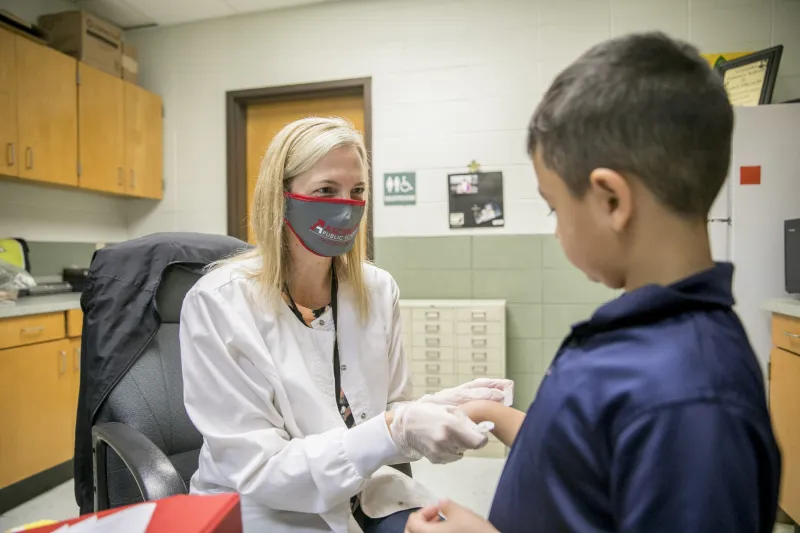
Photo: school nurse examining student in elementary school health office, via resources.finalsite.net
A Building in Every Neighborhood
There is one institution that reaches nearly every child in the United States regardless of income, geography, or family circumstance. It is not a hospital or a clinic. It is a school.
Approximately 49 million students pass through American public school doors each year. They spend roughly six hours a day, 180 days a year, in buildings staffed by trained adults who observe their behavior, monitor their development, and interact with their families. No other institution in the country has that kind of sustained, structured access to the next generation.
For public health advocates, that fact has long carried an obvious implication: schools are not just educational institutions. They are, whether acknowledged or not, one of the most consequential health environments in the nation. The question is not whether schools influence health outcomes—they already do. The question is whether that influence is intentional, systematic, and adequately resourced.
A growing number of school districts, health departments, and education leaders across the country are beginning to answer that question with a resounding yes.
The Case for Starting Early
The scientific rationale for school-based prevention is grounded in decades of developmental research. The years between early childhood and late adolescence are periods of extraordinary biological, neurological, and behavioral plasticity. Habits formed during these years—around nutrition, physical activity, sleep, stress management, and substance use—tend to persist into adulthood. Health conditions that go undetected or unaddressed during childhood often become significantly harder and more expensive to manage later in life.
Type 2 diabetes, once considered an adult disease, now affects more than 352,000 young Americans under the age of 20, according to the CDC. Rates of adolescent anxiety and depression have risen sharply over the past decade, with many cases going undiagnosed until they manifest as crisis. Vision and hearing impairments, when left undetected, silently undermine academic performance and developmental trajectories for years before they are identified.
Early intervention in each of these areas is not merely possible in school settings—it is, in many districts, already happening. The challenge is scaling what works.
Mental Health Screening: The Quiet Frontier
Perhaps nowhere is the potential of school-based prevention more consequential—or more contested—than in the domain of mental health.
In Broward County, Florida, one of the largest school districts in the nation, a universal mental health screening program launched in partnership with local health authorities has identified thousands of students in need of support services each year. The program uses validated screening tools administered at multiple grade levels to flag early signs of anxiety, depression, trauma exposure, and suicidal ideation. Students identified through screening are connected to school-based counselors or referred to community providers, often within days.
"We catch kids at a point when intervention is still relatively straightforward," explained one district mental health coordinator involved in the program. "By the time a family ends up in an emergency room, we've missed years of opportunities."
Similar models have taken root in school districts in Oregon, Texas, and Massachusetts, each adapted to local demographics and available resources. What these programs share is a shift in philosophy: rather than waiting for students to self-identify or for teachers to notice behavioral warning signs, they treat mental health screening as a routine component of student wellness—no different from a vision test or a hearing check.
Chronic Disease Detection in the Hallway
Beyond mental health, schools are also emerging as important sites for early detection of physical health conditions that disproportionately affect low-income and minority youth.
In Chicago, a school-based asthma management program embedded in elementary schools across the city has dramatically reduced emergency department visits among participating students. The program trains school nurses to conduct routine lung function assessments, coordinates with families and community health clinics, and ensures that students with diagnosed asthma have access to medications and action plans during the school day. Hospitalizations among enrolled students dropped by more than 30 percent in the program's first three years.
In rural North Carolina, a coalition of school districts and federally qualified health centers has piloted a model that brings mobile health units onto school grounds during the school day, offering vision screenings, dental assessments, blood glucose testing, and blood pressure checks to students who might otherwise never receive them. For many families in the region, the school has become the de facto primary care setting—not by design, but by necessity.
"For a lot of our kids, this is their only consistent contact with any health service," said one school principal whose campus participates in the program. "If we don't do it here, it doesn't happen."
Health Literacy as a Long-Term Investment
Beyond screening and detection, forward-thinking districts are also making the case for health literacy—the ability to understand, evaluate, and act on health information—as a core academic competency.
In a media environment saturated with health misinformation, the ability to critically assess claims about vaccines, nutrition, and medical treatments is not a luxury. It is a civic and personal survival skill. Yet health education in most American schools remains fragmented, underfunded, and inconsistently delivered.
Some districts are changing that. In Seattle, a redesigned health curriculum introduced in middle schools teaches students not only basic anatomy and nutrition but also how to read a nutrition label, how to evaluate health claims online, how to navigate the healthcare system, and how to recognize signs of mental health distress in themselves and others. Early assessments suggest that students who complete the curriculum demonstrate measurably higher health literacy scores and report greater confidence in health-related decision-making.
The Infrastructure Gap
Despite these promising models, the honest assessment is that school-based prevention infrastructure in the United States remains deeply uneven. School nurse ratios fall far below recommended levels in most states. Mental health counselor caseloads are routinely two to three times higher than professional guidelines suggest. Health education budgets are among the first to be cut when districts face fiscal pressure.
The gap between what is possible and what is currently funded represents one of the most significant missed opportunities in American public health. Economists who have modeled the long-term returns on school-based prevention investment consistently find that early intervention programs generate substantial savings in downstream healthcare costs—often returning several dollars for every dollar invested. But those returns accrue over decades, and in a budget environment driven by annual cycles, long-term payoffs are difficult to prioritize.
A Generation at Stake
The school-based prevention movement is not asking education to become medicine. It is asking that the institutions entrusted with children's development be adequately equipped to address the full range of factors that determine whether those children thrive.
The evidence is clear that when schools are supported in this role—with resources, partnerships, and policy frameworks that reflect prevention as a priority—they change outcomes. They catch conditions early. They build habits that last. They reach families that no clinic ever could.
The children in American classrooms today will be the workforce, the caregivers, and the community members of the next generation. Investing in their health now is not a charitable impulse. It is, by any honest accounting, the most strategically sound prevention investment the country could make.