Storm Shelters and Skipped Checkups: The Paradox at the Heart of American Risk
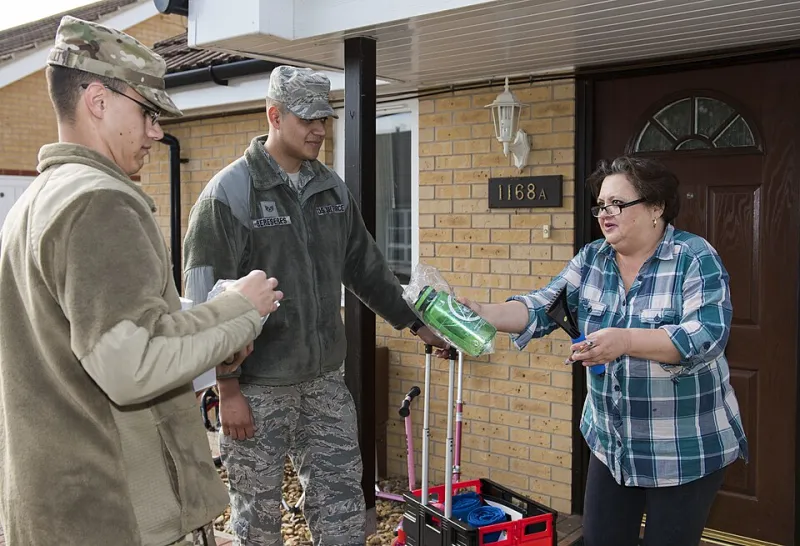
Photo: U.S. Air Force photo by Airman 1st Class Jennifer Zima, Public domain, via Wikimedia Commons
In the weeks following a major hurricane or mass casualty event, hardware stores sell out of generators. Online retailers report surges in emergency food kits. Survival forums light up with checklists for water purification tablets, first aid supplies, and backup power sources. Americans, it turns out, are remarkably motivated to prepare — when they can picture the threat.
And yet, according to the Centers for Disease Control and Prevention, nearly one in three American adults with high blood pressure does not know they have it. Colorectal cancer screening rates remain stubbornly below national targets despite the procedure being widely available and frequently covered by insurance. Millions of Americans who would not hesitate to buy flood insurance decline to schedule a routine wellness visit.
This is not a story about negligence. It is a story about how the human mind processes danger — and why that processing creates a public health crisis hiding in plain sight.
The Architecture of Fear
Behavioral economists have long documented a phenomenon known as availability bias: the tendency to judge the likelihood of an event based on how easily an example comes to mind. A tornado that levels a neighborhood makes the evening news. A community where 40 percent of residents will develop cardiovascular disease over the next decade does not.
This cognitive shortcut, while useful in certain survival contexts, becomes a liability in modern public health. The threats that command the most emotional attention — earthquakes, active shooters, terrorist attacks — are statistically far less likely to kill the average American than heart disease, stroke, diabetes, or cancer. Yet federal emergency preparedness campaigns, Hollywood disaster narratives, and social media algorithms all conspire to keep acute catastrophic risks vivid and top of mind.
Chronic disease, by contrast, operates on a timeline that makes it psychologically invisible. The arterial plaque accumulating over years does not announce itself. The pre-diabetic blood sugar reading does not send an alert. The slowly dividing cells that will eventually constitute a malignant tumor offer no early warning signal that maps onto the human brain's threat-detection system.
Dread Risk Versus Ordinary Risk
Psychologists Paul Slovic and Baruch Fischhoff identified a distinction decades ago that remains deeply relevant to public health communicators today. They described dread risk — characterized by uncontrollability, catastrophic potential, and the sense that exposure is involuntary — as commanding disproportionate fear relative to its actual statistical danger. Nuclear power, plane crashes, and chemical spills fall into this category.
Chronic disease, by contrast, tends to register as ordinary risk: familiar, individually manageable in theory, and associated with personal choices. This framing carries a subtle but consequential implication. If heart disease is ordinary, it feels less urgent. If it is associated with lifestyle choices, it also carries a dimension of perceived personal agency — which paradoxically can reduce rather than increase preventive action, particularly among those who feel they have already made adequate adjustments to their diet or exercise habits.
The result is a landscape in which Americans spend an estimated $54 billion annually on home security systems — protecting against a risk profile that, for most households, is relatively modest — while the nation simultaneously faces a chronic disease burden that accounts for seven of every ten deaths each year.
The Preparedness Framework as a Public Health Tool
What would it look like if public health advocates borrowed the communication architecture of emergency preparedness?
Consider the design logic of a disaster readiness campaign. It begins with a concrete threat scenario, rendered in vivid and specific terms. It moves to an inventory of vulnerabilities — what do you have, what are you missing, where are the gaps. It concludes with a clear, actionable checklist: store three days of water, know your evacuation route, keep important documents in a waterproof container.
This framework is not merely informational. It is motivational. It creates a sense of agency in the face of threat, and it converts abstract danger into manageable steps. There is no structural reason this model cannot be applied to preventive health.
A campaign built on this logic might open with a frank account of what an undetected chronic condition actually does to the body over time — not in the sanitized language of clinical brochures, but in the visceral, consequential terms that emergency preparedness materials use without apology. It would then invite individuals to assess their own preparedness: When was your last blood pressure check? Do you know your cholesterol numbers? Has anyone in your family been diagnosed with colon cancer?
The checklist that follows — schedule a wellness visit, ask your provider about screening eligibility, review your family health history — becomes not a bureaucratic obligation but a genuine act of self-protection.
Community-Level Urgency
The preparedness analogy also offers something that individual health messaging frequently lacks: a community dimension. Emergency preparedness is understood as a collective responsibility. Neighborhoods conduct drills. Cities publish emergency plans. Schools rehearse evacuation procedures. The individual's readiness is framed as part of a shared infrastructure of resilience.
Public health prevention efforts rarely invoke this framing with equivalent force. Yet chronic disease is, in every meaningful sense, a community-level emergency. When a significant portion of a county's adult population is living with unmanaged hypertension, the downstream consequences — strokes, hospitalizations, lost productivity, family caregiving burdens — ripple through every institution in that community.
Some local health departments have begun experimenting with community health preparedness events that deliberately borrow the aesthetics and urgency of disaster readiness — setting up rapid screening stations at community centers, framing the results as a personal health inventory, and connecting participants with follow-up resources before they leave the building. Early evidence from these initiatives suggests that the reframing resonates, particularly in communities with strong disaster preparedness cultures.
Rewriting the Narrative of Risk
The challenge facing public health communicators is not simply one of information delivery. Americans are not unaware that heart disease kills more people than hurricanes. The challenge is emotional and cognitive: how to make a slow, silent, statistical threat feel as real and urgent as the threats for which people willingly overinvest.
This requires more than better data. It requires storytelling that puts a human face on the cost of delayed prevention. It requires community messengers — physicians, faith leaders, employers, coaches — who can translate clinical risk into terms that resonate with specific audiences. And it requires a willingness to borrow, unapologetically, from the playbook of emergency preparedness: the concrete scenario, the vulnerability inventory, the actionable checklist, the community imperative.
Americans have demonstrated, repeatedly, that they are capable of taking prevention seriously. The question is whether public health advocates can make chronic disease feel like the emergency it already is.
The storm is already here. The shelters are free. Most of us have simply not yet looked up.